
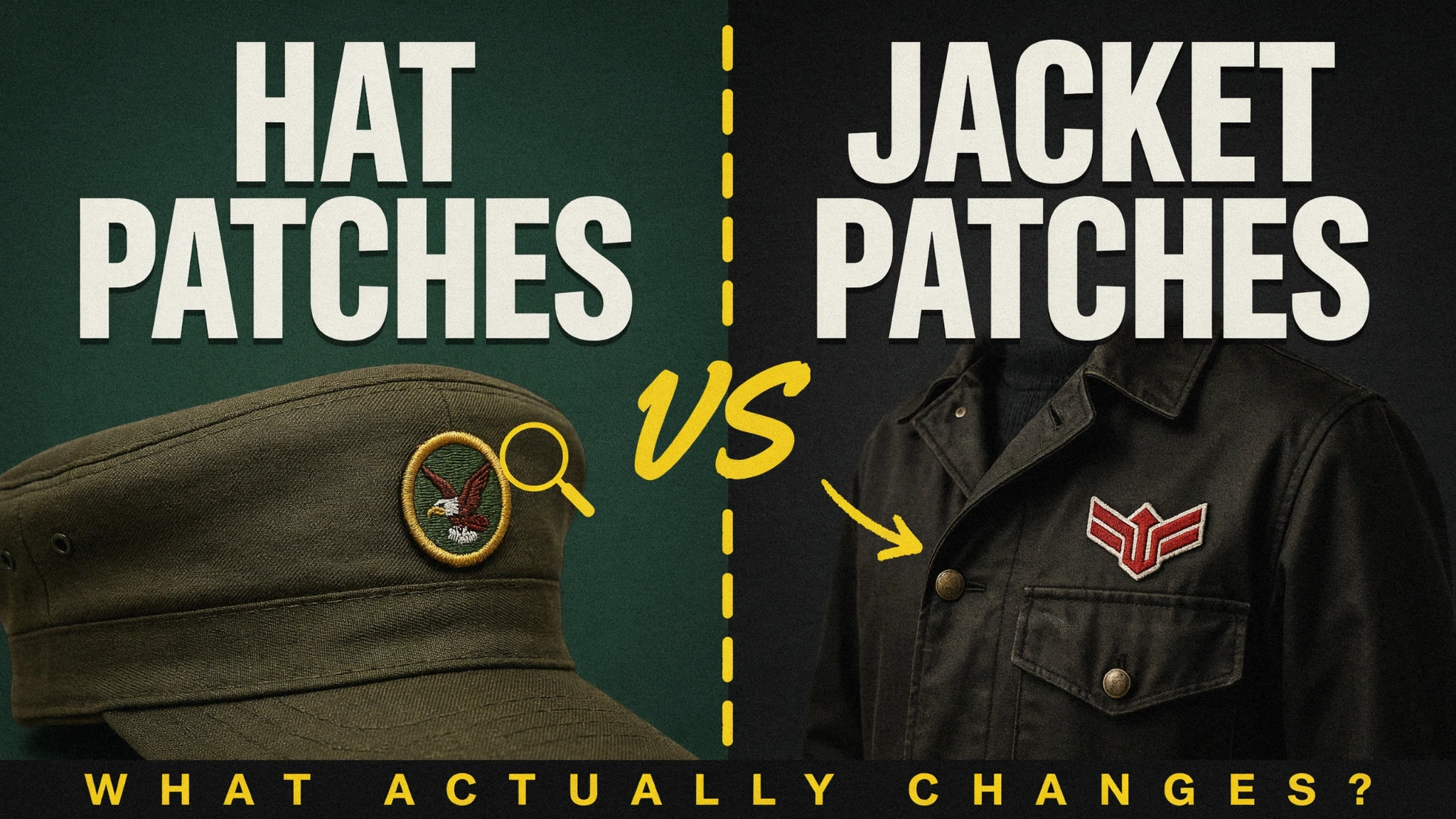
A patch that looks right across a jacket back can overwhelm the front of a baseball cap. Custom hat patches vs jacket patches comes down to usable space, structure, attachment, and artwork.
Those differences affect more than appearance. A curved crown, jacket lining, fabric coating, seam position, washing routine, and intended wear can all change the specifications sent into production.
For businesses ordering custom patches in the USA, planning the garment first prevents expensive sizing mistakes. The same logo can work on both items, although each application usually deserves its own dimensions and production setup.
Why the Garment Changes the Patch
Hats give designers a compact surface shaped around the head. Jackets provide chest, sleeve, shoulder, and back locations, creating considerably more freedom for custom logo patches and detailed artwork.
That is the practical starting point for Custom Hat Patches vs Jacket Patches. The garment determines the available canvas before embroidery percentage, border, backing, thread color, or shape enters the conversation.
Anyone choosing the patch construction itself can first compare how embroidered patch materials and stitching work before deciding how that construction should be adapted for headwear or outerwear.
Hat Patches and Jacket Patches at a Glance
| Factor | Hat Patches | Jacket Patches |
| Available surface | Compact and curved | Larger, mostly flatter placement areas |
| Common locations | Front crown, side, rear, beanie cuff | Chest, sleeve, shoulder, upper back, full back |
| Artwork approach | Simpler shapes and readable details | Greater room for lettering and complex compositions |
| Patch thickness | Usually kept controlled | Can support heavier and more dimensional styles |
| Attachment | Sew-on or compatible heat application | Sew-on, heat seal, hook-and-loop, or specialty attachment |
| Strong style choices | Embroidered, woven, leather | Embroidered, chenille, woven, leather, PVC |
| Main sizing concern | Crown height and seams | Garment size, panel dimensions, pockets and lining |
| Common buyers | Brands, teams, events, workwear | Clubs, schools, businesses, teams, fashion labels |
A useful custom hat patches vs jacket patches decision therefore starts with placement instead of choosing an arbitrary three-inch or four-inch patch and attempting to make it fit later.
Hat Patch Size Starts With the Crown
The available front panel on a cap is surprisingly shallow. SanMar decoration specifications show front areas around 2.25 inches high on several common cap constructions, with exact dimensions changing by style.
That explains why hat patch size should be measured against the actual blank cap. Crown profile, center seams, front-panel construction, and the desired visual margin matter more than a universal measurement.
For custom hat patches vs jacket patches, hats normally demand greater restraint. An artwork file with three lines of tiny wording may need simplification once its usable vertical space becomes clear.
Front-Crown Patches
Most custom hat patches use the front because that position receives immediate visibility. Rectangles, compact shields, circles, ovals, and controlled custom shapes usually sit cleanly within structured cap panels.
OTTO CAP lists several standard patch formats between roughly two and four inches across, depending on shape, and stresses that decoration limits change with headwear construction.
That makes embroidered patches for hats particularly effective for bold logos, initials, mascots, badges, and short wording. Fine lettering deserves a proof at the intended finished dimensions.
Trucker Hats, Snapbacks, and Five-Panel Caps
Structured fronts give trucker hat patches useful support, particularly for rectangular logos and centered badge shapes. A softer dad cap may require a smaller, more flexible patch to follow its crown.
Five-panel hats also remove the center seam found on many six-panel caps. That uninterrupted face can be helpful when the artwork contains a central symbol or narrow lettering.
Detailed logos can benefit from woven patch construction when the finished patch needs thinner thread and finer visual definition than conventional embroidery comfortably provides.
Jackets Open Up Far More Placement Space
A jacket provides several independent decorating zones. SanMar jacket specifications commonly show four-inch chest areas, with substantially larger back panels available depending on the garment, construction, and decoration method.
This changes custom hat patches vs jacket patches considerably. A designer can create a restrained chest identifier, separate sleeve emblem, large back centerpiece, or coordinated group of patches on one garment.
The correct jacket patch size should still come from physical measurements. Jacket size, pockets, yokes, seams, waistbands, hoods, interior insulation, and existing embroidery can reduce the apparent open area.
Chest and Sleeve Patches
Smaller custom jacket patches work naturally on the left chest, right chest, upper arm, or shoulder. These placements suit business logos, names, club identifiers, commemorative emblems, and team marks.
Sleeves need extra attention because the arm creates its own curve. Compact artwork normally reads more clearly there, especially when the design contains text that needs to remain visible from several angles.
Jacket Back Patches
The back gives patches for jackets their largest visual opportunity. Motorcycle emblems, event artwork, fashion graphics, organization crests, and large team identities can occupy space unavailable on ordinary headwear.
Large denim jacket patches also allow artwork to breathe. More room can preserve secondary text, internal borders, separate color fields, and recognizable illustration details that would become crowded on a cap.
Embroidered, Woven, Leather, or Chenille?
Material selection has a direct effect on custom hat patches vs jacket patches because every patch type creates a different thickness, texture, detail level, weight, and visual character.
Classic custom embroidered patches suit both garments when the design depends on visible thread texture, clear borders, solid lettering, and a familiar stitched finish.
Embroidery Works Across Both Categories
Embroidery handles recognizable logos particularly well and gives baseball cap patches a strong tactile appearance. It also suits jacket chests, shoulders, workwear, motorcycle apparel, uniforms, and large decorative layouts.
The smaller cap format usually needs cleaner artwork. A jacket gives the digitizer more physical room, which can preserve additional lettering, outlines, color separations, and internal design elements.
Woven Patches Help With Smaller Detail
Woven construction uses finer threads and can reproduce tighter artwork. This can be valuable when a hat logo contains smaller typography or details that become muddy at conventional embroidery scale.
Jackets can use woven patches too, especially for fashion labels or detailed insignia. Their flatter appearance creates a different visual result from the raised stitch texture associated with embroidery.
Leather Fits Heritage and Workwear Styling
Leather patches for hats are common on trucker caps, outdoor branding, workwear merchandise, breweries, ranch-inspired labels, and businesses seeking a restrained retail appearance.
Leather can also suit denim and work jackets. Attachment should be planned around the specific leather patch, garment shell, lining, and care requirements before holes, adhesive, or heat are introduced.
Chenille Belongs Naturally on Statement Jackets
The plush surface of custom chenille patches gives chenille jacket patches the dimensional texture associated with school letters, sports culture, collegiate styling, and bold fashion pieces.
That makes varsity jacket patches a strong use case for chenille. Larger letters, numbers, mascots, and simple symbols give the raised yarn enough space to create the intended visual weight.
Backing Is a Garment Decision
Attachment is another major custom hat patches vs jacket patches difference. The safest choice depends on the fabric, surface shape, wash routine, permanence required, and the manufacturer’s care instructions.
The site’s existing breakdown of iron-on, sew-on, hook-and-loop, adhesive, and other backing choices is useful here because backing should follow the real application rather than convenience alone.
Sew-On Backing for Hats
Sewing gives a permanent mechanical attachment without requiring the whole crown to receive application heat. It can be especially practical for structured hats, performance materials, or pieces intended for frequent wear.
The curved shape still makes positioning important. Custom hat patches vs jacket patches become visible during installation because a patch that sits perfectly flat on a table may behave differently around a cap.
Heat Application on Hats
Iron-on hat patches require more care because consistent heat and pressure are harder to achieve across a curved crown. Commercial cap presses use shaped platens designed specifically for that geometry.
Stahls publishes separate cap-press application specifications for its patch products, including controlled time, temperature, pressure, and padding requirements. That reinforces the value of following the patch supplier’s exact application settings.
Some polyester, nylon, coated, or performance hats also require special care when heat is introduced. SanMar repeatedly advises decorators to account for fabric composition and coating before heat application.
Permanent Attachment on Jackets
Sew-on jacket patches are useful for denim, workwear, club jackets, and other garments expected to receive repeated wear. Stitching also avoids depending solely on a heat-activated adhesive layer.
A sew-on finish can be ordered through custom sew-on patch options when long-term attachment is part of the project specification instead of an afterthought.
Check the Jacket Care Label Before Heat
The FTC requires covered textile apparel to carry care instructions and warnings when expected care procedures could harm the garment. Heat-sensitive jackets should therefore be checked before any iron or press touches them.
This matters for coated shells, polyester outerwear, waterproof layers, lined jackets, and mixed-material pieces. A compatible heat-seal patch option still needs a compatible garment underneath it.
The Artwork Should Change With the Application
Artwork preparation often settles custom hat patches vs jacket patches before material selection does. A logo containing tiny slogans, dates, outlines, and multiple symbols may need separate hat and jacket versions.
Simplify Small Hat Designs
Cap artwork benefits from a clear hierarchy. Keep the primary name, icon, initials, or emblem readable first, then retain secondary details only when the finished dimensions still support them.
This is particularly important for custom hat patches carrying corporate identities. Shrinking a desktop logo without editing it can reduce letter openings, merge narrow spaces, and make several design elements compete visually.
Give Jacket Artwork the Space It Deserves
Large custom jacket patches can support richer compositions, especially across the back. Clubs, schools, apparel brands, artists, event organizers, and sports programs can use size to separate visual elements properly.
The extra room does not require filling every inch. Strong jacket artwork can contain deliberate empty space, a single central emblem, or several coordinated elements arranged around the garment’s own construction.
Borders and Shapes Need Different Thinking
Rounded, oval, shield, and rectangular formats frequently work well on hats because their edges can follow a compact visual footprint. Custom-cut shapes also work when protruding sections remain proportionate.
A jacket can carry far more irregular silhouettes. Flames, mascots, lettering systems, rockers, state outlines, large crests, and multi-piece arrangements have room to work across broader panels.
The border itself deserves attention during custom hat patches vs jacket patches planning. Thick borders consume more of a small cap patch’s usable area, and that tradeoff becomes less severe on larger jacket artwork.
Which One Is Better for Different U.S. Buyers?
The best garment depends on what the patch is supposed to accomplish. Custom hat patches vs jacket patches becomes easier once visibility, wear frequency, merchandise price, uniform purpose, and audience are defined.
Choose Hat Patches For:
- Branded baseball caps and snapbacks
- Brewery, restaurant, and retail merchandise
- Landscaping, construction, and trade crews
- Sports teams and local clubs
- Outdoor and hunting-inspired apparel
- Promotional headwear
- Small-batch streetwear drops
- Event merchandise
A hat keeps the branding visible near eye level and works as an easy everyday merchandise item. Embroidered patches for hats also allow one patch design to be applied across compatible cap styles.
Choose Jacket Patches For:
- Motorcycle clubs and riding groups
- School and collegiate apparel
- Work jackets and staff uniforms
- Fashion collections
- Team outerwear
- Commemorative designs
- Large organization emblems
- Multi-patch layouts
Organizations using military-inspired outerwear may also need removable identification or morale-style elements. Material, symbolism, and attachment considerations for those projects are covered within military patch construction and ordering considerations.
Can the Same Design Be Ordered for Both?
Yes, although one production file should not automatically dictate both finished sizes. The central logo can remain consistent, then dimensions and minor details can be adjusted for each garment.
That approach gives custom hat patches vs jacket patches stronger visual consistency across a merchandise line. A brand can retain the same colors and identity without forcing identical physical proportions.
For example, a wide company emblem may become a compact front-cap patch and a larger jacket-back version. The jacket edition can preserve a tagline that the cap edition removes.
Does One Type Cost More?
There is no fixed hat-versus-jacket pricing rule because size, quantity, embroidery coverage, material, backing, and artwork complexity affect production. Larger jacket designs can naturally use more material and stitching.
USA Custom Embroidered Patches publishes pricing across multiple patch sizes, quantities, and construction types, with larger specifications receiving different rates. Pieces above its listed size range require a custom quote.
That makes custom hat patches vs jacket patches a specification question before it becomes a price question. Comparing two patches at different dimensions without matching material, coverage, backing, and quantity gives an incomplete cost comparison.
What to Tell Your Patch Maker Before Ordering
A useful quote request contains more than a logo attachment. Give the production team enough information to evaluate the actual garment instead of creating an isolated patch.
Include:
- Exact hat or jacket type
- Intended patch location
- Maximum width and height available
- Artwork file or clear reference
- Desired patch material
- Required quantity
- Preferred backing
- Expected washing or outdoor exposure
- Whether the patch must be removable
- Any deadline for an event, launch, or team season
A photograph of the blank garment can also help when placement is unusual. Measurements taken directly from the intended area are more useful than estimating dimensions from another finished product.
FAQs
Can I use a jacket patch on a hat?
Sometimes. A small flexible jacket patch may fit, although large or stiff designs can sit poorly around the crown, so the dimensions and construction should be checked first.
What size patch works best on a hat?
There is no single universal measurement. Measure the intended cap panel and leave enough clearance around seams, the visor, and crown edges so the hat patch size remains proportional.
Are sew-on patches better for jackets?
They are a dependable choice for many frequently worn garments. Sew-on jacket patches create a mechanical attachment, and suitability still depends on the jacket material, lining, construction, and intended appearance.
Can an iron-on patch go on a baseball cap?
It can when the patch and hat material support heat application. Iron-on hat patches should follow the specified temperature, pressure, and time, with extra attention given to curved surfaces.
Which patch type works best for a varsity jacket?
Chenille remains strongly associated with letterman styling because its raised texture suits large letters, numbers, and mascots. Embroidery can handle smaller names, dates, crests, and supporting details.
Are hat patches and jacket patches made differently?
They can use the same manufacturing methods, including embroidery and weaving. Dimensions, flexibility, artwork density, backing, and border choices often change because the two garments provide very different application surfaces.
Is embroidery or woven construction better for a detailed hat logo?
Woven construction can accommodate finer visual detail because it uses thinner threads. Embroidery creates more noticeable texture, so simple logos and bold lettering often translate especially well into embroidered cap patches.
Can patches be applied to waterproof jackets?
Possible application methods depend on the particular shell and coating. Some waterproof garments need specialized decoration procedures, and puncturing or heating them can affect performance, so garment-specific guidance should be followed.
Match the Patch to the Garment
A good custom hat patches vs jacket patches decision begins with the surface receiving the patch. Hats favor compact, carefully proportioned designs; jackets create room for larger artwork, varied placements, and heavier styles.
USA Custom Embroidered Patches can turn the same brand identity into garment-specific versions, with artwork preparation, backing choices, sizing, and digital proofs adjusted for the intended use.
Our custom patch production for U.S. orders includes multiple patch constructions and design support before production begins. If you already have a logo, sketch, existing patch, hat, or jacket specification, send the measurements with your artwork. The team can build a patch that fits the garment instead of making the garment accommodate the patch.

Emma Carter