
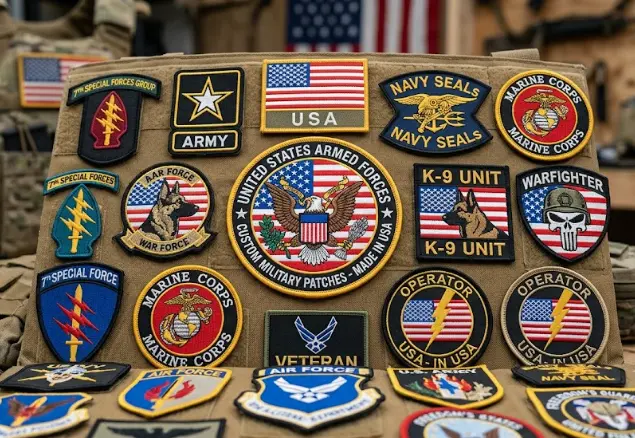
No other fabric symbol carries as much significance as a military patch. Just one little insignia can tell so many stories about a unit’s legacy, a soldier’s rank, a mission accomplished, and the relationships forged while overseas.
If you have ever wondered how to order a military patch that is ready for battle and proud to wear on your uniform or jacket, this guide on custom military patches is for you.
Be it outfitting an entire company, retiring an officer, or creating your own collection that represents your military background, this article explains all there is to know about custom patches and the process from materials to symbolism and ordering procedures.
What Custom Military Patches Are and Why They Matter
Custom military patches refer to the patches of cloth or synthetic materials that are manufactured to denote a particular unit, rank, mission, or morale identity. Patches have three uses within the military force and its associated institutions.
- Identification. Patches help distinguish branch, unit, and rank at a glance, which matters in joint operations, training environments, and formal ceremonies.
- Tradition. Many unit patches date back decades and are redesigned only slightly with each generation, preserving a visual link to the unit’s history.
- Morale. Unofficial custom morale patches let service members express humor, pride, or camaraderie in a way official insignia cannot.
Custom military patches find wide usage outside active duty in veteran associations, ROTC and JROTC units, honor guards, military-related events, re-enactment groups, and collectors who keep alive their unit’s history in physical artifacts.
A Brief History of Military Patch Traditions
Shoulder sleeve insignias have their origins in World War I, where there was a need to have clear identification among the growing numbers of military men. Shoulder patches gained popularity and significance during World War II and served as a source of pride, as well as a means of indicating which unit the soldier belonged to.
The morale patches are a less formal form of the tradition that came about because of similar reasons, especially in tactical and special operations circles, where patches have become a norm in units.
That is one of the main reasons why the authenticity of patches is such a big deal now. Not only do patches that are poorly sewn with incorrect thread density or wrong color scheme look cheap, but they miss out on the heritage as well.
Types of Custom Military Patches: Materials Compared
The selection of the material used will influence the appearance of the patch, its longevity, and its durability in the field environment. Below is a comparison of the four most popular types of patches.
Embroidered Patches
Custom military embroidered patches are the traditional choice for military uniforms and remain the most widely used option. The thread is sewn on top of a fabric base and creates a raised and textured effect with a traditional design.
Additionally, a 3D embroidered patch version is also available for a raised design. Embroidery patches withstand multiple washes and are standard for dress uniforms and unit patches.
The disadvantage of embroidered patches is that the fine details get lost due to the dense stitching. This is the reason most of the embroidery providers suggest a minimum text size for embroidered designs.
PVC Patches
Custom PVC (polyvinyl chloride) patches are molded rather than being stitched like an embroidery patch, marking the difference between embroidered vs. PVC military patches. Their surface feels more rubberized and raised. They are resistant to water and mud.
That is why it has gained popularity in tactical wear, plate carriers, and outdoor equipment that is exposed to tough conditions. PVC offers great color separation, which makes it highly suitable for use in morale patches that have many graphics.
Woven Patches
Custom woven patches are made of a denser weave and are thin, whereas embroidered patches use thick threads. This means that woven patches can be used for detailed and complex designs that include small text. Woven patches are also flat in appearance and have a sleek finish, which is preferred by certain units on their uniforms.
Chenille Patches
Custom chenille patches are made from a fabric that is known to be soft and fuzzy. They are mostly attached to varsity jackets or letterman jackets. In addition to having a distinct texture, it is also very rare to be found on any active uniform other than certain ceremonial, alumni, or veteran organization patches.
Quick Comparison Table:
| Material | Best For | Detail Level | Durability |
| Embroidered | Dress uniforms, unit patches | Moderate | High |
| PVC | Tactical gear, outdoor use | High (bold graphics) | Very high |
| Woven | Fine text, detailed insignia | Very high | High |
| Chenille | Ceremonial, veteran, heritage patches | Low (bold shapes) | Moderate |
Morale Patches: Where Personality Meets Uniform
Custom morale patches are unofficial and exist apart from unit patches; they allow members of the military to add some fun or personality to equipment, instead of wearing patches on their uniforms.
Morale patches can be found most often sewn to a hook-and-loop patch on backpacks, plates, and range bags, not on a duty uniform. Morale patch designs run from unit inside jokes to pop culture references to symbolic designs that carry their own meaning.
A custom yin yang patch is one of the common types of military patches within this category, often produced in subdued or OCP-matching colorways and used to represent balance, duality, or a lighthearted counterpoint to more serious unit and rank insignia on the same kit.
As morale patches are not linked to regulatory insignia, they can afford much greater flexibility in terms of form, colors, and imagery compared to the US military branch patches or unit patches would allow.
Most of the morale patches are either manufactured in PVC form or embroidered form depending on the intended application of the patches. PVC patches have been found to last longer when applied to equipment that is frequently exposed to the field compared to the embroidered ones.
But the classic touch of embroidered patches still is the most popular patch type preferred by military personnel for military uniform patches. The raised, timeless design is found everywhere from educational institutions to corporations and from uniforms for forces to uniforms for various professions.
OCP Patches and Camouflage-Matched Production
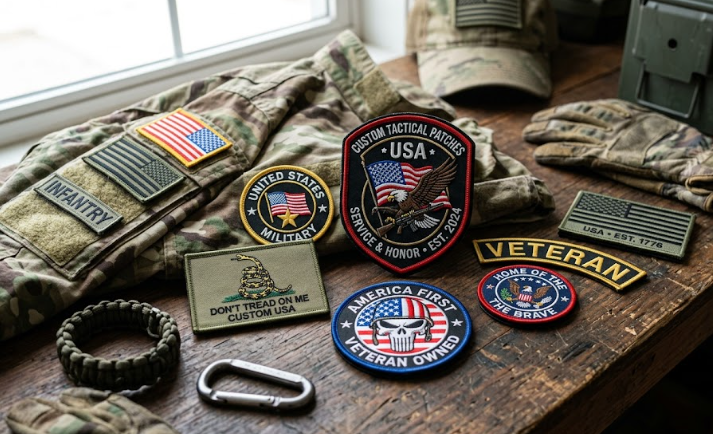
“OCP,” an acronym for Operational Camouflage Pattern, is the type of camouflage pattern used on many of the United States Army uniforms and increasingly in other branches for their field uniforms.
Custom OCP patches for uniforms are made in order to match or complement this camouflage pattern and are usually in a subdued tan/green/gray scheme as opposed to the flashy colors of dress uniform patches.
Subdued OCP patches are often requested for use on official unit insignia to be worn on the field uniform, as well as for morale patches, which will fit in seamlessly with the OCP uniform.
In the case of OCP patches, the color choice is particularly important because any color that is even a little bit too bright or just a tad off will be noticeable against the uniform or the gear. In this case, a supplier using Pantone-matched colors would definitely do a better job than a supplier using generic colors.
Backing and Attachment Options
How a patch attaches to a uniform or gear matters as much as the material itself. Below are the common military patch backing options:
- Hook and loop (Velcro): The standard for contemporary tactical uniforms, enabling the patches to be swapped from one mission or piece of equipment to another.
- Sew-on: A long-lasting and secure way of attaching patches. More appropriate for dress uniforms where the patch will not be taken off.
- Iron-on: A convenient option for softer applications such as caps, bags, and civilian apparel, though not typically specified for combat uniforms.
- Adhesive Peel-and-stick: Good for temporary applications but not recommended for uniforms that will undergo frequent wear and washing.
Military Patch Symbolism: Colors, Shapes, and Icons
Custom military patches follow a kind of visual shorthand that has developed over generations.
- Colors may be indicative of the branch of service, type of mission, or unit designator. Field uniforms employ subdued colors, whereas dress uniforms use full color.
- Shapes such as shields, circles, diamonds, and arrowheads often carry historical significance tied to a specific division or command.
- Icons including wings, stars, anchors, and weapons typically represent branch affiliation, specialty qualification, or mission focus.
- Abbreviations and mottos identify specific units, squadrons, or missions and are often the most closely guarded design element for authenticity.
It is especially important to be aware of the meaning behind the military patch symbolism when redesigning one from the past, as even slight errors in the design will misrepresent the unit’s actual lineage.
Patch Traditions Across the US Armed Forces
Each branch of the US military has its own patch conventions.
- Army: Shoulder sleeve insignia identify division and corps affiliation, with combat and garrison versions often differing in color treatment.
- Navy: Rate and command patches follow strict specifications, with ship and squadron patches offering more design flexibility for unofficial use.
- Air Force and Space Force: Squadron patches are known for creative, mission-specific designs, particularly among flight and space operations units where morale patch culture is especially strong.
- Marine Corps: Unit patches emphasize tradition and heritage, often referencing campaign history alongside current mission designations.
- Coast Guard: Patches frequently reflect specific operational commands, such as cutter or air station assignments, alongside standard rate insignia.
Rules and Regulations Around Custom Military Patches
Uniform insignia patches follow branch-specific military patch regulations regarding their location, size, and approval, while patches to be worn on a duty uniform must always be checked with respect to current unit and branch policies before ordering.
Custom morale patches worn on tactical uniforms receive somewhat less scrutiny, although unit commanders can establish their own policy guidelines.
When it comes to veteran groups, ROTC programs, and civilians who make military-style patches, it is always useful to confirm whether the branch insignia, seals, or historical unit patches that will be reproduced fall within organizational guidelines. This guide serves an educational purpose and is not meant to substitute for official uniform guidelines.
How to Design and Order Custom Military Patches
Below are the steps of designing and how to order custom military patches:
1. Define the purpose. Determine whether the patch is for an official uniform, a morale patch, a unit event, or a keepsake, since this affects material and backing choice.
2. Submit artwork or a concept. A logo, unit crest, or rough sketch is enough to start. Our design team can also build a design from a written description of colors, symbols, and text.
3. Choose material and backing. Match the material and backing to how the patch will actually be used, based on the comparisons above.
4. Review a digital mockup. A proof should be reviewed and approved before production begins, with revisions available at no extra cost.
5. Confirm size and quantity. Standard patch sizes range from 2 to 4 inches, though custom shapes and sizes are available for unit-specific designs.
6. Approve and produce. Once approved, production typically moves into stitching or molding, followed by quality control and finishing.
Bulk Ordering for Units, Squadrons, and Veteran Groups
When you are outfitting a whole unit, graduating class, or veterans’ club, you need something different from just one custom patch.
When you place an order in bulk quantities, you can save a lot on each patch with wholesale discounted patch prices, and the quality control becomes even more important than usual because every person in that unit must receive a patch that looks the same.
If your club plans to place an order in bulk, our specialists can help you with everything from prices to payment terms.
Caring for and Displaying Military Patches
Active duty patches should always be spot cleaned or hand washed to ensure that the stitching is maintained, especially in case of embroidered or chenille patches, which are more prone to damage through tough cleaning procedures. PVC and woven patches can endure more rigorous washing and remain intact in most cases.
However, collectors need to store the patches, once taken out of service, away from direct exposure to sunlight and moisture in shadow boxes, display cases, or acid-free sleeves.
Choosing the Right Custom Military Patch Supplier
It is important to keep in mind that not all suppliers have the necessary qualifications for creating high-quality patches according to the military-grade specifications.
While selecting a supplier, one should pay attention to the supplier’s experience with the creation of patches that match the durability requirements and the color precision, as well as the revision and proofing process and realistic lead times for both single orders and large-unit orders, as well as experience working with veterans’ organizations, ROTC programs, and unit associations.
Frequently Asked Questions
What is the difference between embroidered and PVC military patches?
Embroidered patches have a traditional look for uniforms, while PVC patches, made from flexible plastic, offer durability and weather resistance. Selection depends on prioritizing appearance or tough conditions.
How do I get authorization to wear a custom military patch on a duty uniform?
Wearing patches on official duty uniforms follows branch regulations and local policies. Morale patches on tactical gear have more flexibility. Verify current policies with your chain of command for accuracy.
What is the minimum order quantity for custom military patches?
Minimum order quantities differ by supplier. Many producers can do both single and bulk orders. Smaller orders have higher costs per patch, while bulk orders lower prices significantly.
How long does it take to receive custom military patches after ordering?
Turnaround time for custom military patches varies by material and complexity, typically estimated post-design approval. Digital mockups take a few days. Rush options may be available for urgent orders.
Order in Bulk and Save for Your Unit or Organization
In choosing the perfect custom military patches, you have to take into consideration not only what the patch will be made of but also how it will be worn: in a dress uniform, on tactical gear, or displayed.
This custom military patches guide talked about all the factors that will go into making the best custom military patch, including what materials to use, symbols to put in, and how to order your own patch. If you are ready to get embroidered patches made in USA, then a professional patch maker can make it happen.
Equipping an entire unit, batch, or organization? We have special pricing levels tailored to the needs of military units, veterans’ organizations, and event planners that require uniformity in quality for bulk production with schedule flexibility based on your event date. Contact us today and get a free quote.

Emma Carter