

When it comes to getting custom patches for staff or employee uniforms, you must have come across the dilemma of embroidered vs. woven patches. Both make for a good sight on jackets, hats, or backpacks.
Made out of thread, manufacturing processes for both patch types are fundamentally different, and by making a wrong choice, you might end up with a patch that has a blurred inscription, which feels too rigid to be sewn onto your fabric, or a custom patch that costs more than it should have cost.
This guide will give you detailed information on both embroidered and woven types of custom patches and the scenarios when it would be better to choose one over the other.
What Is an Embroidered Patch?
A custom embroidered patch features a basic material such as twill, alongside the design that is stitched directly on the base through the use of thick and dense threads. Digitizers transform artwork into a stitch file while the embroidery machine develops it in layers through individual stitches to fill in colors and outlines.
Due to the fact that the thread lies on top of the fabric and not woven within, it results in an embroidered patch having texture and a three-dimensional appearance. You can touch the embroidered patch with your fingers and be able to feel the stitches used to form it.
Embroidered patches have been seen for ages in designs such as military and police badges, motorcycle gang patches, varsity letters, and outdated company logos.
What Is a Woven Patch?
The construction of a custom woven patch is quite different from scratch. As opposed to sewing thread to a piece of fabric, a woven patch is sewn on a special kind of loom using very fine threads, which are interwoven to create the design. There is no underlying piece of fabric being covered by the design.
In other words, the threads themselves are the patch. Due to the fact that threads used in weaving are thinner than those used for embroidery, woven patches may contain many more details in less space. The text is readable, the lines are clear, and gradients/photographic parts will look clean and sharp without blending with other details.
Embroidered vs. Woven Patches: Side-by-Side Comparison
| Factor | Embroidered Patches | Woven Patches |
| Texture | Raised, three-dimensional, tactile | Flat, smooth, low-profile |
| Detail capacity | Best for bold shapes, larger text, simple lines | Best for fine text, thin lines, gradients, complex logos |
| Thread | Thick, dense thread built up in layers | Thin thread woven into the design itself |
| Durability | Very high; thick stitching resists heavy wear | High; performs well but is less bulky than embroidery |
| Flexibility | Stiffer, more structured | More flexible, lighter, better for thin or stretch fabric |
| Visual style | Traditional, classic, handcrafted | Modern, sharp, closer to a printed finish |
| Best applications | Uniforms, jackets, tactical gear, club patches | Caps, polos, small logos, detailed branding, athletic wear |
| Typical cost | Slightly higher for larger, detailed designs | Generally more cost-efficient for high-detail work |
None of the styles can be considered superior in all cases. The optimal option depends on the requirements of the design and the place where the patch will be applied. A number of aspects such as the target audience, the general look of the project, and the functional requirements for the patch are important factors when choosing the best style for the design.
For example, an eye-catching and bright style can be more appropriate for a young brand looking to attract attention and express the dynamic nature of the project, while minimalism would better appeal to the target audience of professionals.
In addition, the application context of the patch is another factor affecting the final choice since it can depend on whether it will be worn as clothing and accessories or used as promotional materials.
It is important not only to pay attention to the visual aspect but also take into account the compliance of the selected style with the overall concept of the design project.
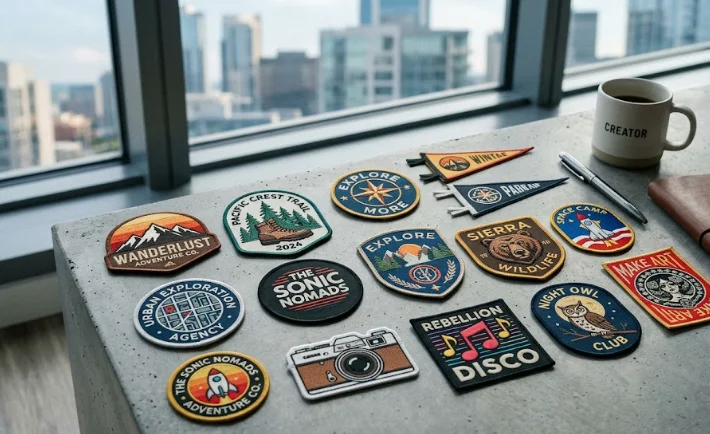
ALT Text: A collection of custom embroidered and woven patches arranged neatly on a smooth concrete tabletop next to a modern office window overlooking a city skyline.
When Embroidered Patches Are the Better Choice
When the need is to emphasize the importance of existence and sustainability over pixel perfection, the embroidered patches are the best option.
When the design is made up of some bold font styles, geometric shapes, or a clear-line logo design with little fine text, then you should consider going for the embroidered patch since they also come with a three-dimensional look that will photograph and look good when viewed from a distance.
The sturdy, robust stitching of the embroidered patches is able to endure heavy washing, abrasion, and even weather, hence making the embroidered patch the go-to choice for military, emergency services, motorcycle gangsters, and letterman jackets.
This kind of patch not only shows the quality of the fabric but also the attitude towards personal and collective identity that most people who use these patches hold dear.
What makes embroidered patches more special than printed patches is that the latter will fade away with time, while the former are bright and durable, preserving the image or idea that they represent.
This is due to the fact that the artistry of embroidered patches lies in the process of intertwining threads into unique designs. Moreover, the texture that is characteristic of embroidery is one of the main strengths of embroidered patches.
The physical element becomes especially significant when it comes to areas where pride and honor are being displayed through wearing embroidered patches. This includes things like uniforms worn by military members and athletes playing on a particular team.
Fashion evolves, which means that the integration of patches into contemporary fashion can prove to be successful. They can help people find a way to express themselves and create a sense of unity among group members.
They can become a popular addition to different types of clothing and accessories that fashion lovers are going to buy in the nearest future. As a result, whether people are going to wear an embroidered patch on a backpack or on a tactical jacket sleeve, it will become an integral part of their lives.
When Woven Patches Are the Better Choice
Woven patches come into play when your design becomes intricate. Tiny text, which is below a certain point size; thin outlines; multicolor gradients; or a logo with detailed interiors tends to be blurry or unclear when embroidered due to the thickness of the thread used.
However, with woven patches, all of this becomes possible with no loss in clarity as the threads are thin enough to allow for tracing of the intricate patterns accurately. This accuracy makes it possible to create logos and other artwork that can be accurately captured by the process.
Woven patches have an advantage over embroidery since embroidery uses thick threads that make it difficult for a designer to achieve the same level of clarity in designs as is possible using woven patches.
In addition, the lightweight and flexibility of woven patches make them a better fit for use on caps, polo shirts, and performance clothing where the bulkiness of an embroidered patch may not work well.
The lightness of the woven patch ensures that the wearability of the garment is improved and the comfort and style remain unhampered by the inclusion of heavy patches. This feature of the woven patch is extremely useful in sportswear and activewear where comfort is of utmost importance.
If you want your design to have a crisp, contemporary look on a detailed logo, then the woven patch is likely the better choice. Not only are there advantages in the ability to customize, but there is added value in durability since the woven patches are less prone to fray or tearing than the embroidered patches, thus giving them greater longevity as well.
Furthermore, woven patches come in a great range of shapes and sizes, offering an endless supply of options for customizing your design while still having that clean and polished look about them. As such, they have become quite popular among designers and businesses that wish to leave a lasting impression through quality branding.
Cost and Durability: What Actually Drives the Price
The pricing for both types of patches is based on the size of the design, number of thread colors used, type of backing, and quantity ordered rather than only the production process itself.
In general, embroidered patches with the stitching that covers the whole patch will cost slightly more due to the use of more thread and more machine hours per patch, particularly the larger the patch.
Woven patches are a somewhat more economical option for intricate designs since getting such an intricate design in an embroidered patch would mean more work in digitization and use of more stitches to prevent the muddy look.
In terms of durability, both types of patches are equally durable and withstand regular wear and wash cycles as well as outdoor exposure if applied correctly and backed.
Embroidered patches have an upper hand in terms of abrasion resistance due to the thickness and density of the stitching, and this is one of the reasons why these patches are still considered standard for tactical and workwear apparel.
Woven patches come second and work efficiently for many years in fashion, retail, and promotional applications, thanks to their ability to replicate complex designs and tiny texts found on company logos and emblems.
How to Choose: A Quick Decision Framework
Ask these three questions before placing your order:
- Does your design include small text, fine lines, or gradients? If yes, choose woven. If your design is bold and simple, embroidery will handle it well and give you more texture for the price.
- What fabric is the patch going on? Thick jackets, uniforms, and outerwear can support the structure and weight of embroidery. Thin fabrics like performance polos, caps, and lightweight jackets often look and feel better with the flatter, lighter profile of a woven patch.
- What look matches your brand? A traditional, handcrafted, three-dimensional look points to embroidery. A sleek, modern, high-resolution look points to woven.
In case you are still in doubt after asking these questions, our experts evaluate art daily and within minutes will inform you what type of construction is best suited for your particular design.
Frequently Asked Questions
Are woven patches equal to embroidered patches?
Woven patches have fine thread, but embroidered patches have thick thread that results in a flat design and good detail.
Which patches are more durable, embroidered or woven?
Embroidered patches are more durable because they are abrasion resistant and therefore can be used for military and tactical purposes, while woven patches are better for retail purposes.
Which patches are more economical, embroidered or woven ones?
Woven patches are more economical to use when dealing with detailed work because they give a clean design and are cheaper compared to embroidered patches.
Can I include small text on my embroidered patch?
It is advisable to include text in embroidered patches with bold lettering because small lettering tends to become blurred in embroidered patches. Woven patches are better when using small text.
Still Not Sure Which Style Fits Your Design? We Can Help
In case the logo you have designed contains tiny fonts and thin lines or a combination of both bold and intricate design details, you might want to have a quick chat with the expert team at USA Custom Embroidered Patches prior to ordering.
We can assess your graphic file and provide you with all the information concerning how it will appear when stitched using the embroidery technique or woven patches, so there will be no doubts about it.
When it comes to picking out embroidered vs. woven patches, the choice will depend upon your design and its ultimate placement. Embroidery patches come up with a classic 3D look and higher durability. In contrast, woven patches provide you with flat graphics with high resolution, which is quite useful in creating complex designs with text.
Simply opt for the technique that suits the most with your graphics and material, and your patch will become a timeless creation. In case you are not clear regarding either of the options, feel free to contact us for expert advice and get a free quote.

Emma Carter